

1440 has been valued at $101 million
27-person daily newsletter doing $1M in revenue per employee. The economics behind it, and what the comps actually say.


Hello everyone, and happy Tuesday,
It’s no secret that newsletters are booming. From 8- to 9-figure exits like Morning Brew, Axios, and The Free Press to platforms like Substack and beehiiv going mainstream, or even my girlfriend asking me why every founder has a damned newsletter now. It’s the new thing, or better said, has been for a few years, and the masses are catching on.
1440 is a daily newsletter I’ve been reading for some time now, and it was recently valued at $101 million, with $27 million in annual revenue, and only a 27-person team. So how did a “simple” newsletter get to this position, and where is the money coming from?
First time here? We analyze the deal flow and market trends we come across for independent buyers, search fund operators, and anyone seriously considering buying or selling a company.
In short
1440 is a bootstrapped 27-person daily newsletter doing $27M in all-ad revenue. A 409A mark from an investment bank valued it at $101M (3.74x).
Curated newsletters like 1440 command ~$8.50 CPCs. Each email reaches ~2.8M readers, and each sponsorship generates $60K to $100K.
70% paid growth, 30% organic. Paid acquisition runs at $1M/month with a ~$3 CAC and a 4-month payback.
Morning Brew (3.8x) is the only clean comp. Every higher multiple in the space was either strategic (HubSpot, NYT, Paramount) or subscription/B2B (Athletic, Industry Dive).
Doubling down on AI-replaceable evergreen content is the wrong play. The right one is using their distribution to launch independent vertical brands or a venture arm.
1440 is precisely the romantic kind of media company people fall in love with. Their name is drawn from the 1,440 minutes in a day, and also the year Johannes Gutenberg invented the printing press.
The newsletter was founded in 2017 by Tim Huelskamp, Andrew Steigerwald, and the late Pierre Lipton, with an email sent to 78 friends and family members that offered a five-minute, unbiased briefing on what was going on in the world.
Today, that same email is sent to over 4.7 million subscribers. Their Daily Digest reads 100+ sources every morning and extracts an unbiased briefing that is reviewed by at least five colleagues. They’ve also introduced a library of evergreen explainers covering topics from business and finance to health and medicine. Alongside it sit multimedia properties like a podcast and a YouTube channel.
All of it fuels on their flagship newsletter, rather than a Google ranking or a social feed they’re renting.
A daily newsletter valued at $101 million
According to CEO Tim Huelskamp, the company received a third-party valuation of $101 million earlier this year, as originally reported in On Background by Mark Stenberg.
You typically hear a number like this after a fundraising round or an acquisition. 1440 is neither looking to raise capital nor exit. The team holds equity, the company distributes dividends, and the IRS requires a third-party fair value for options and share pricing, so they had an investment bank mark the business at 3.74x revenue.
$1 million revenue per employee
$27 million in annual revenue is impressive even by SaaS standards. To put things into perspective, this single newsletter generates more than half of what either Substack ($45M) or beehiiv ($34M) generated last year. The economics are incomparable, but the scale is no joke.
I spoke to Teddy Burkhardt, VP of Content at 1440, who confirmed that all of that revenue comes from ads.
And 1440 does this with a bootstrapped 27-person team. Around this time two years ago, they were doing $15m in revenue with 15 people. They’ve maintained that ratio over the past two years, and none of the comps match it. Morning Brew, Axios, and The Free Press all carried far bigger teams, and most took venture money.
The advertising economics
To understand the numbers, I looked at sponsorship rates for two sets of newsletters:
“Curation” brands like Superhuman AI, Techpresso, and Morning Brew.
“Legacy” names like Business Insider, Inc, Entrepreneur, Fast Company, and a few others.
There’s not much science to my picks, but I took the average cost per click for every brand, then the median of each group, with 28 brands across both groups.
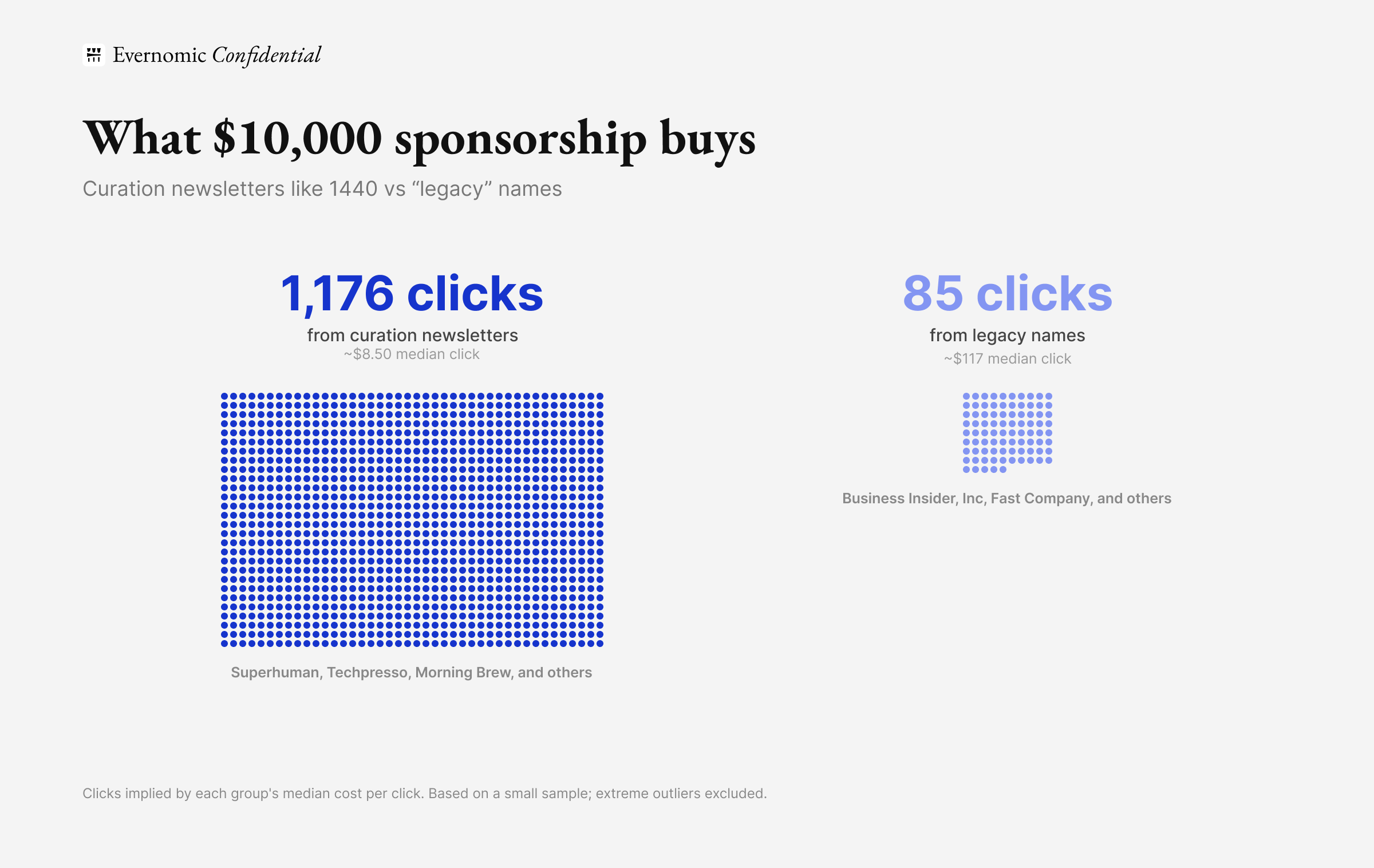
At a similar scale, the first group lands around $8.50 per click. The second group sits near $117 per click, with some even running past $350, which is essentially just a prestige buy and an anomaly. The legacy names often get opened out of habit or when a headline catches your eye, which is reflected in their click-through rates. But people pay more attention to the curators with a clear voice.
1440 doesn’t publish its rates publicly, but we can guess. With 60% open rates and 4.7 million subscribers, there’s roughly 2.8 million opens per email. Price that at the former CPC rate, and a main sponsorship comes out around $60k to $100k. AdWeek pegged the flagship near $100,000 per day, which lines up.
Growth channels and paid acquisition
With $1 million in monthly ad spend, approximately 70% of 1440's growth comes from paid channels, with a ~$3 CAC per double-opt-in subscriber. This helps their case against media companies that can’t explain where their audience comes from, other than by throwing around the word “organic”.
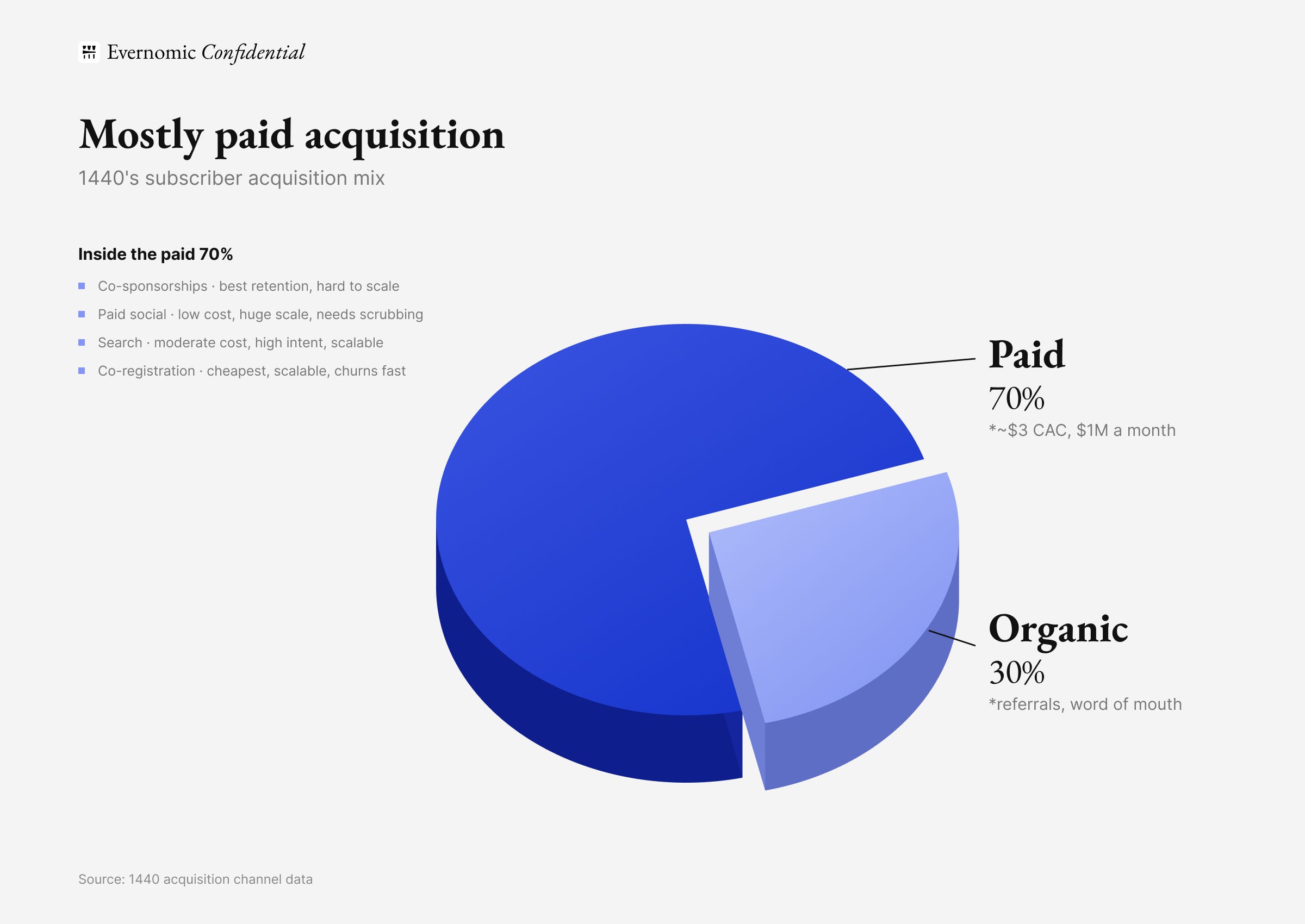
Tim mentioned in an interview with Press Gazette that their revenue per opened email is around $0.05. Assuming a monthly cycle of 25 emails and 60% open rates, resulting in approximately 15 opens per month per subscriber:
Monthly revenue per subscriber = 15 opens * $0.05 = $0.75/month
Consequently, the payback period for capital deployed in paid marketing is around 4 months. The remaining growth is organic, driven by word of mouth and over 2 million followers across Instagram, Facebook, and X.
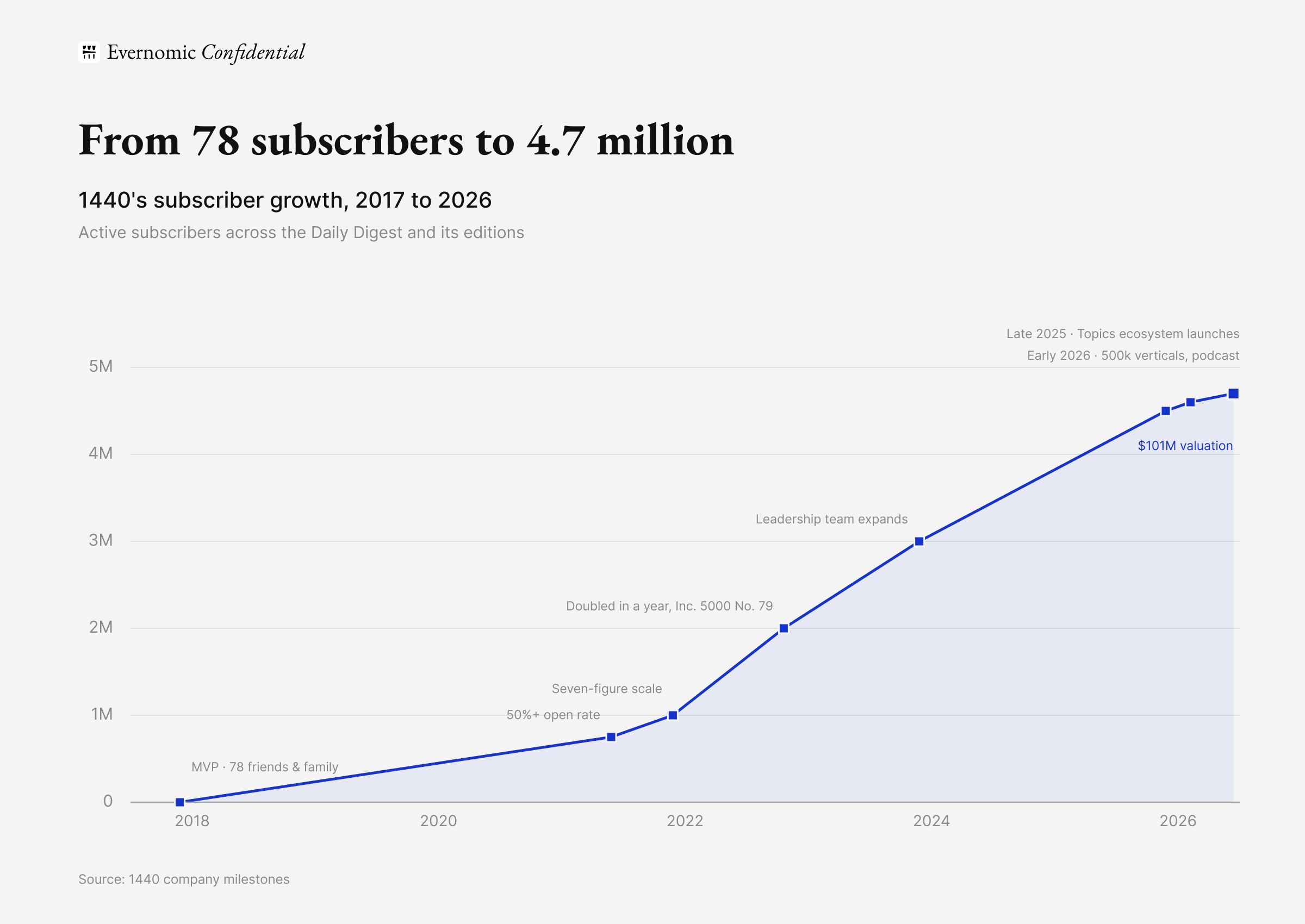
Given that they bootstrapped, their growth strategy hasn’t always been so reliant on paid channels:
0–1,000 Subscribers: Solely focused on content and feedback loops.
1,000–50,000 Subscribers: Low-cost channels like cross-promotions and DojoMojo giveaway sweepstakes.
50,000–100,000 Subscribers: Revenue was funneled into Facebook Ads with CAC between $1.00 to $2.00.
100,000–500,000 Subscribers: Diversified acquisition across other channels, including Google, Reddit, Pinterest, Quora, and LiveIntent.
500,000–Present: Scaled programmatic acquisition to over 300,000 new subscribers monthly, testing over 1,500 ad creatives per quarter via external agencies.
They also run a strict list-cleanup schedule, with re-engagement campaigns as the first step before any inactive subscriber gets removed.
Comps
The only clean comp for 1440 is Morning Brew. Insider acquired it in October 2020 for around $75M in cash, with the founders retaining a minority stake and an earn-out. It was tracking over $20M in revenue and $6M in profit that year, and profitable since 2018. Ad-supported, free, general audience. Sold at 3.8x revenue.
Although, admittedly, the newsletter space was much less competitive in 2020.
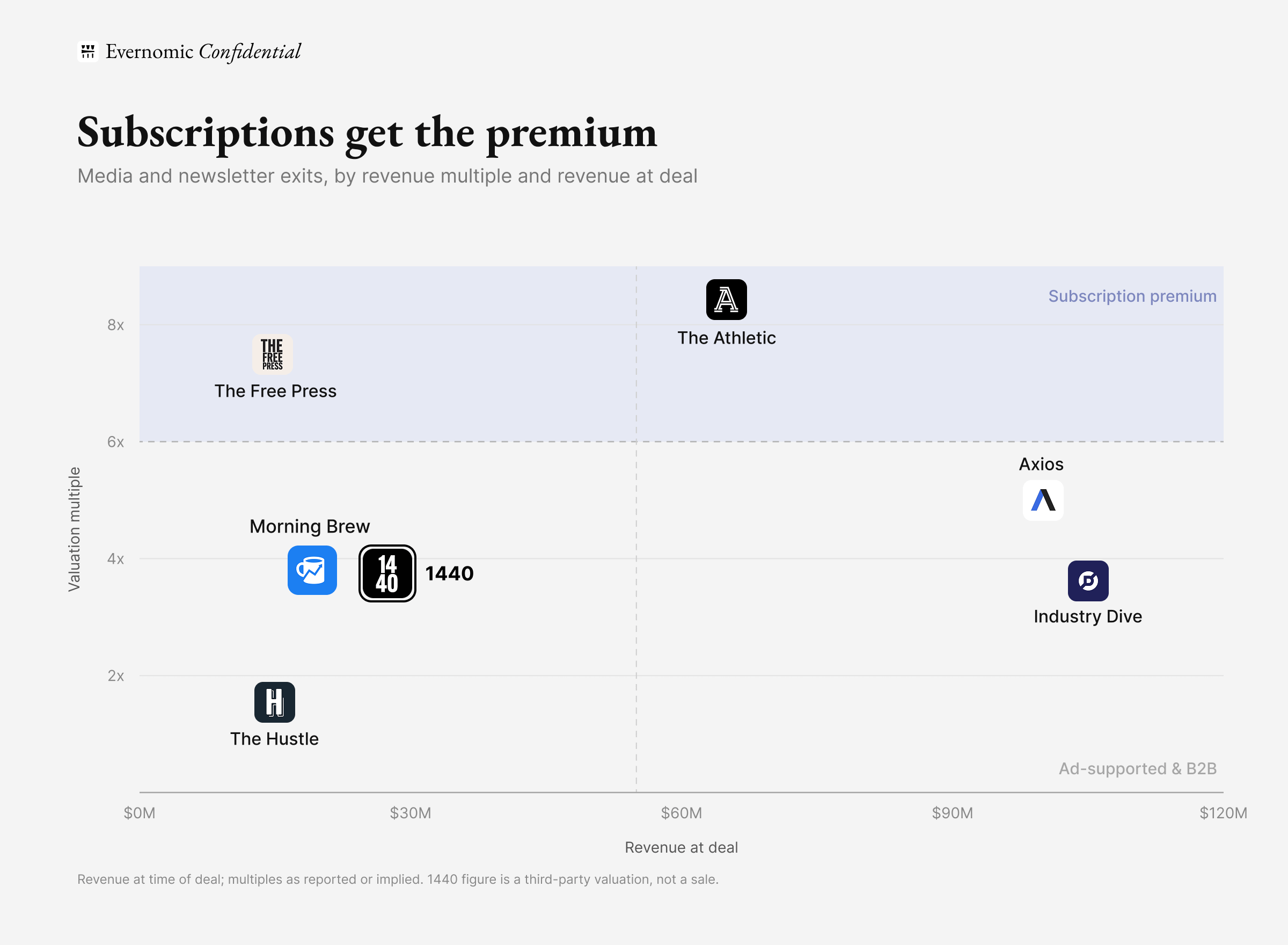
Other comps may trade at high multiples, but that’s either due to strategic integration or a subscription-based revenue model.
The Hustle sold to HubSpot in 2021 for $17.2M cash per HubSpot’s SEC filing (not the widely spread $27M). HubSpot bought the audience at under $2/sub to feed its SaaS funnel.
Axios sold to Cox in August 2022 for $525M, roughly 5x on $100M+ revenue. Profitable for three prior years but at a loss in 2022 as it pushed into local. Cox was also positioning for political ad inventory ahead of the midterms and 2024 elections.
Industry Dive sold in 2022 for $389M cash, about 5x revenue, and 11.4x EBITDA. Pure B2B across 27 trade publications, PE-owned pre-sale. The premium is recurring revenue tied to high-intent professional audiences.
The Athletic sold to the NYT in January 2022 for $550M all-cash, 8.5x on 1.2M paid subscribers. NYT paid because those subscribers fit in their premium content push.
The Free Press sold to Paramount Skydance in October 2025 for $150M, 7.5x on ~$20M ARR (170K paid, 1.5M total). The deal also installed Bari Weiss as Editor-in-Chief of CBS News, which certainly influenced the terms.
Every high multiple was strategic. A financial buyer, search fund, or PE likely wouldn’t have paid those numbers. And the high multiples cluster around subscription or B2B revenue, not ad-supported, general-audience revenue.
So 1440, valued at $101 million, is forward-looking and not a discount.
What could justify a 9-figure valuation?
Traditional digital publishers (e.g., BuzzFeed, Vice) experienced catastrophic value destruction due to their reliance on search traffic. 1440’s email list is insulated from search engines and AI conversational tools that increasingly disintermediate standard web traffic.
However, 1440 is doubling down on generalist evergreen content right as AI commoditizes exactly that. Low-depth, high-breadth educational content is the most AI-replaceable format and serves as an SEO asset in a world where search traffic is collapsing.
I don’t see the need to become an education company. 1440 is an informer. Once you’re part of someone’s routine, the brand sticks. I’d leverage that to build other independent brands that don’t cannibalize 1440.
But not in the way Morning Brew or Axios have.
Think about it: when someone says “Morning Brew,” how many think of the flagship newsletter vs. their adjacent verticals like Tech Brew or Marketing Brew? Morning Brew will always be tied to its flagship, and 1440 should be too.
New ventures need their own identity.
They can launch new media brands and beat every competitor on the economics by using their existing distribution as the launch channel. Their audience may be general, but there are specialists in any large enough group. Those specialists can become higher-value subscribers in dedicated brands, rather than remaining “cheap” inventory on the main list.
Plus, this strategy lets you exit the new brands before multiples begin to decline as they scale. The proceeds could even fund more passive investments.
I know firsthand that some of the largest media outlets are launching venture arms, and some plan to rely solely on their prestige and ad credits within their own distribution as their entire buy-in. 1440 could beat that on every level.
Tim is a private equity guy himself. He probably knows this better than I do.
Evernomic Confidential only covers third-party deals we come across. We never write about anything Evernomic represents or holds a financial interest in. This analysis is for informational purposes only. It isn’t investment, financial, or legal advice, and we can be wrong. Do your own diligence before acting on any deal.
interesting analysis. lots to learn from this one
A really insightful read!!