

My Top 7 Favorite M&A Newsletters in 2026
What makes M&A newsletters worth reading, or better yet, worth subscribing to?

Today, I will take you through my 7 picks for the best M&A newsletters and what makes each one special in my reading experience. These examples I carefully selected to showcase the variety of styles and approaches commonly used.
I have only been writing and reading M&A newsletters for approximately 2 months. My experience has been interesting to say the least… How is a buyer going to interpret this? How much opinion should I include? Does this even make sense? These questions frequent my mind more than I’d like to admit when I’m writing. That’s why it’s important to learn from those who have nailed it already.
The 7 M&A Newsletters I’ll be covering today
What makes a good M&A Newsletter
Through my recent experiences, I’ve noticed six criteria that make an M&A newsletter valuable and enjoyable to me. I have selected my 7 picks through the lens of these factors, so keep them in mind.
1. A point of view, not a feed. Anyone can list and describe deals. Newsletters worth inbox space must tell you what a deal means below the surface. What the headline missed, or what the seller is not saying. I want to see the angle and the risk.
2. Actionable value. Curated beats comprehensive. One deal explained well beats fifty deals dumped in a list. A good newsletter respects your time.
3. The right job for the moment. Some you read for the breaking headline; some for the slow, deep take (the analysis pieces). The best readers stack two or three that do different jobs.
4. Credibility of the writer. Who’s behind it? A sourced journalist, a data house, an operator who’s actually bought companies? The byline is half the product.
5. A format you’ll actually open. Skimmable, consistent shape, reads fine on a phone. If you dread opening it, it doesn’t matter how smart it is or who wrote it. Goes hand in hand with point two, a well-written newsletter respects your time.
6. An edge you can’t get elsewhere. Off-market deals, proprietary data, exclusive interviews, or simply a take you trust. The best ones give you something the free firehose can’t.
The 7 M&A Newsletters
1. Axios Pro Rata
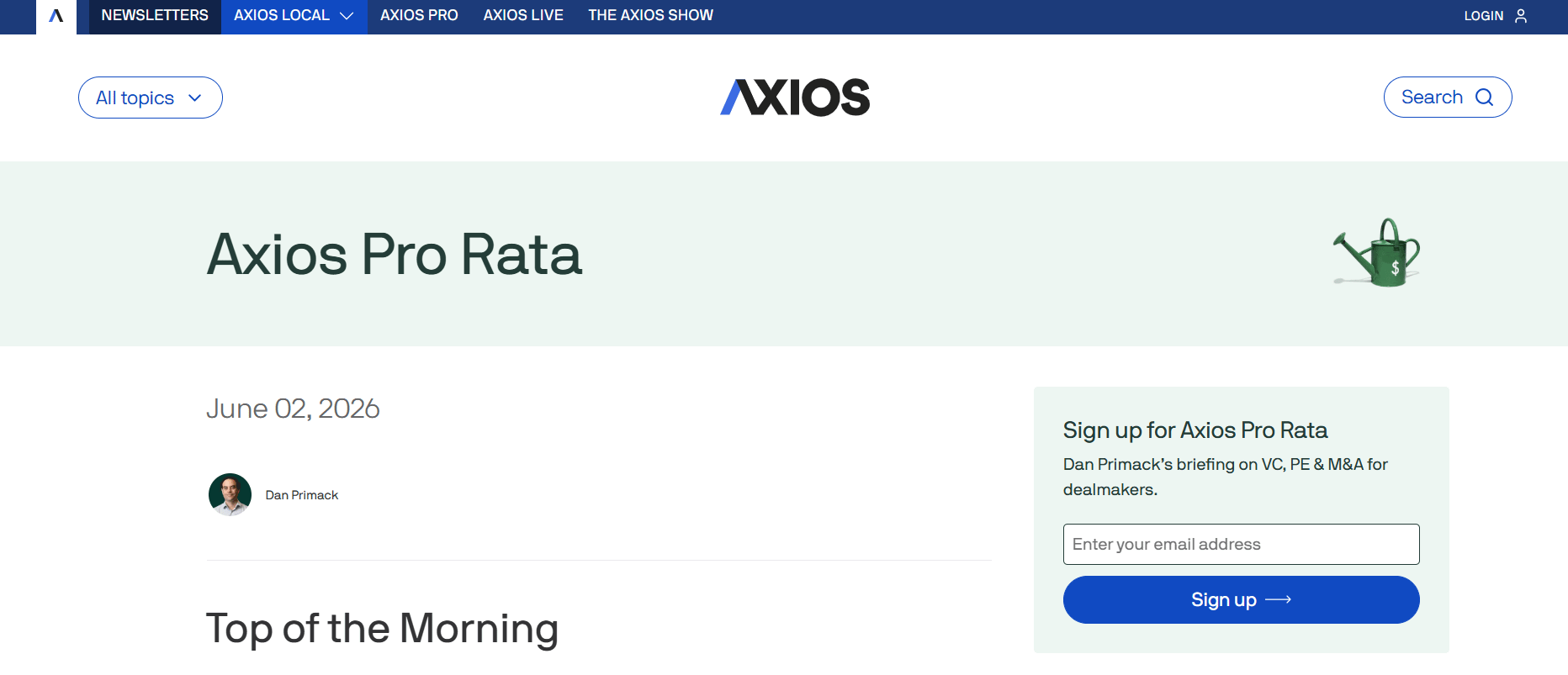
Axios Pro Rata by Dan Primack sets the bar for me, hence earning #1 on my list. It’s “newsy but with a take.” And covers mergers and acquisitions (M&A), venture capital deals, private equity investments, public offerings, liquidity events, and significant personnel changes in the corporate world. It’s targeted towards dealmakers and gives detailed insights with a point of view. It has a daily cadence and is free, which is almost unfair for the quality (Axios monetizes elsewhere).
This newsletter is very broad; it is a combination of VC + PE + M&A + the politics of business rather than just pure M&A. Detail is not compromised; you will be left with up-to-date, in-depth knowledge of recent significant financial transactions and market movements. Making it an ideal read for anyone interested in the latest developments in the financial and corporate sectors.
2. Evernomic Confidential
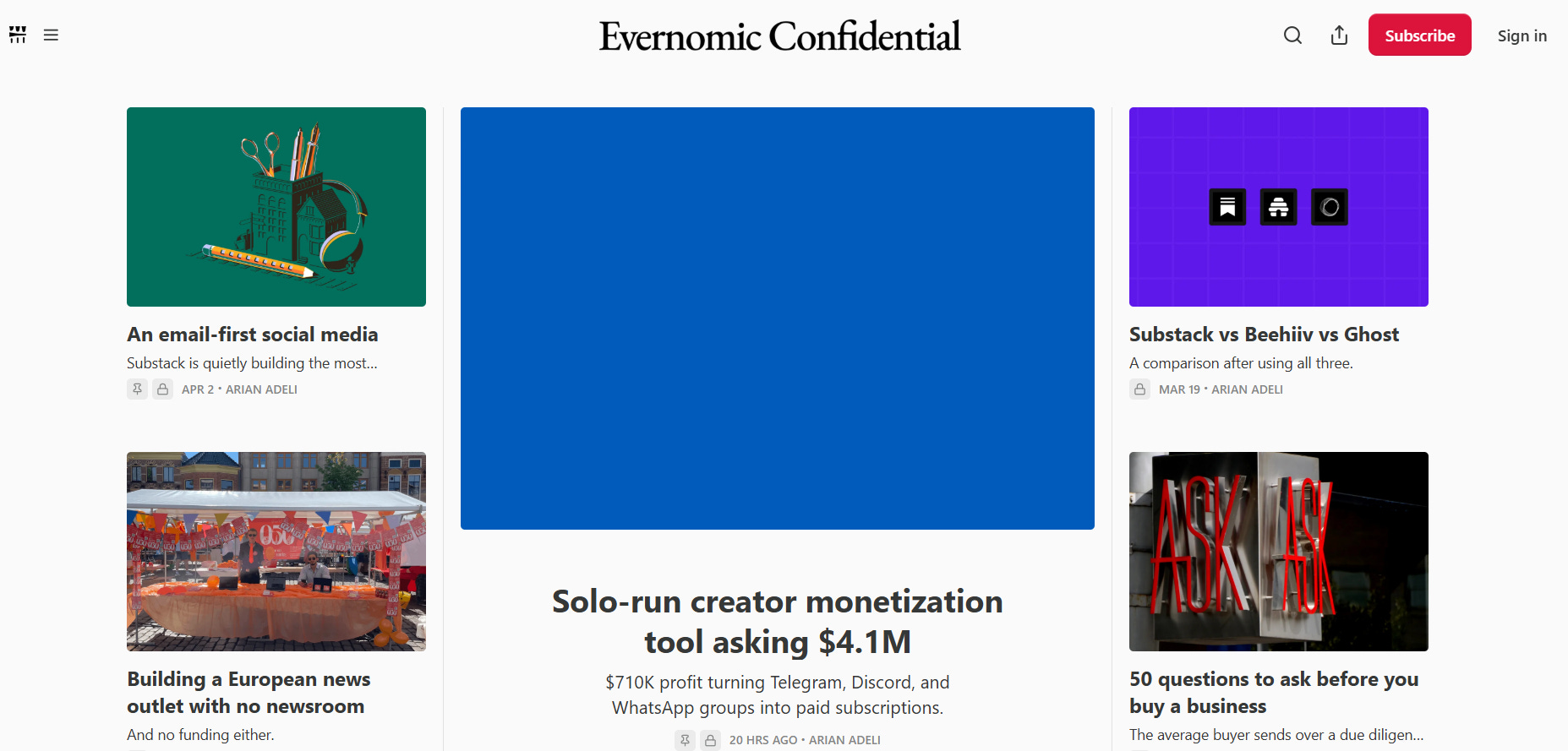
Okay, you caught me. Yes, I put my own newsletter at number two. But I’d be a hypocrite to write about what makes a great M&A newsletter and then leave out the one I’m pouring everything into. Evernomic Confidential is a publication in which we analyze deal flow and market trends we’re seeing for independent buyers, search fund operators, and anyone seriously considering buying or selling a company. Run by myself and Arian Adeli (the founder).
What we aim to do is fundamentally different from any other M&A newsletter. We take a company currently on the market and analyze it the way a buy-side advisor would: the financials and what the seller is or isn’t showing you, the risks we’d want to pressure test, where we see upside, how it holds up against competitors, and the industry context you need to make a decision. We are not running broker advertisements; every deal is anonymized. We focus on software, saas, AI, and media companies (the digital business realm).

3. SMB Deal Hunter
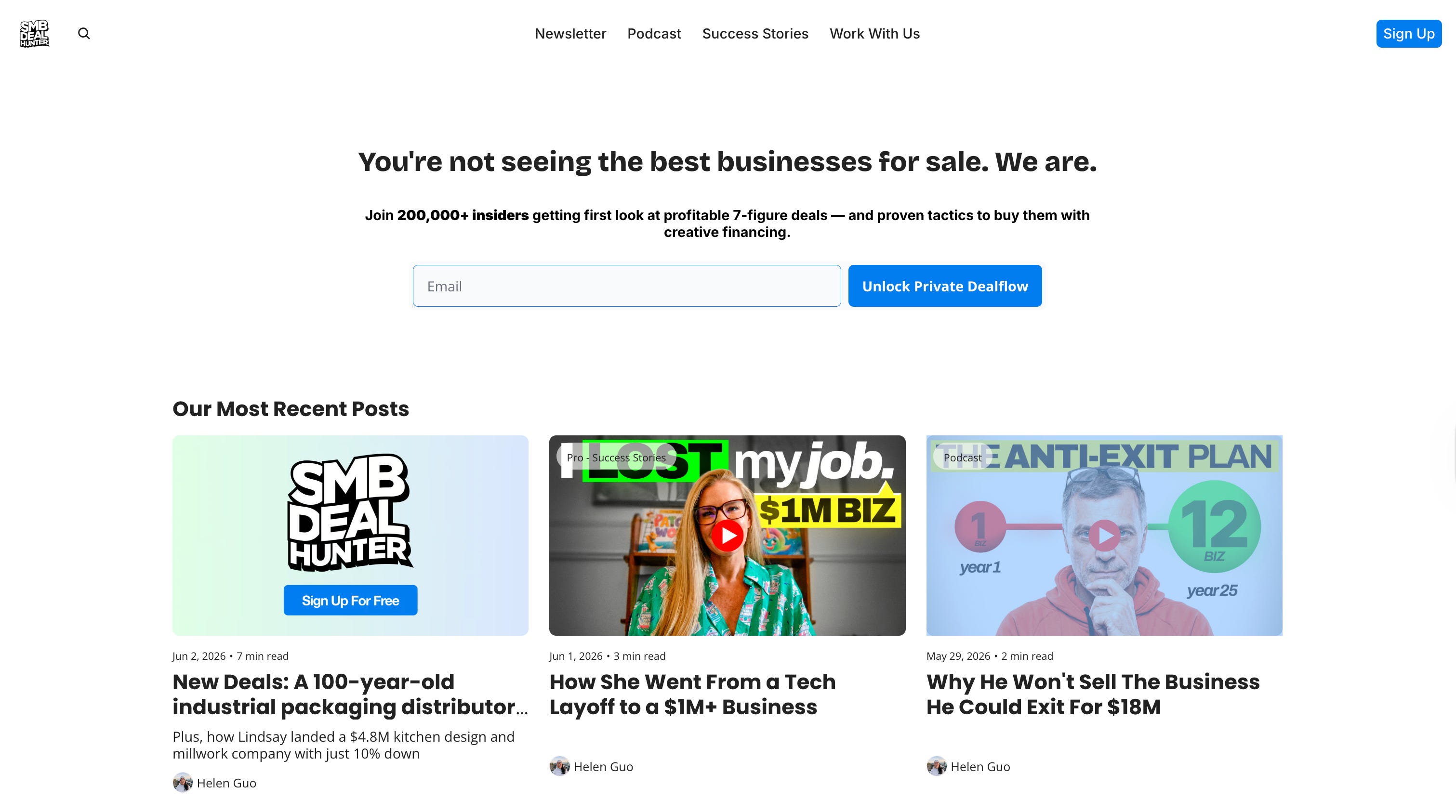
SMB Deal Hunter by Helen Guo is actually the first M&A newsletter I came across and subscribed to. It is heavy on the buyer success stories with tactical case studies. She leans into creative financing (seller notes, earnouts) and the how to actually close it, rather than just describing a listing.
With 200,000-plus subscribers, it’s the biggest name in the search-fund and SMB-acquisition niche for good reason. It’s free, with a paid Pro tier if you want more. SMB Deal Hunter is entrepreneurship-through-acquisition territory, not institutional M&A. Making it ideal for those actually looking to close a deal rather than just admiring. The focus is on off-market businesses profiled before they hit the public marketplaces, adding an extra layer of value.
4. Reuters
Reuters is a news section, not a curated email like the others in this list, however it has earned a spot because it can be stacked on-top of an analysis centered newsletter where Reuters gives you wire-service speed and neutrality, usually first to the announcement, anywhere in the world, across every sector. There’s only the facts, which is the exact opposite of an opinion-led newsletter and a useful opposite to have in your stack. It covers significant business transactions, market deals, and financial news that impact the stock market and business landscape.
5. PE Hub

PE Hub is the professional’s tab, specifically catered towards professionals and stakeholders in the private equity industry. It gives you exclusive coverage and executive interviews you won’t get off the wire. It’s organised into sector verticals (healthcare, tech, energy and so on), so you can go deep in whatever niche you care about, behind the pen is the PEI Group meaning you are getting institutional credibility. It runs on a freemium model, and the premium material sits behind a paywall. You can expect private equity deal news, exits and fundraises.
And guess what? PE Hub was originally created by Dan Primack, the same Dan Primack behind my number one, back in his Thomson Reuters days.
6. The Daily Pitch (PitchBook)

The Daily Pitch by PitchBook news team is for the reader who wants the data under the story. PitchBook is a Morningstar company making the edge is obvious: it’s backed by their proprietary dataset, so you get charts and figures the other newsletters simply can’t cite. It covers VC, PE and M&A with that data spine running under every story.
Yes, it’s partly a free taste of a famously expensive platform, and sometimes it reads like top-of-funnel for the terminal; however, it’s still genuinely useful, and free is free. I’d pair it with an opinion newsletter similar to Reuters.
7. Exec Sum

Exec Sum is the proof that finance and humor scale. It comes from Litquidity: “Lit”, the pseudonymous personality behind a whole finance-meme empire, and it’s the “straight news, with a wink” arm of that brand. 300,000-plus readers get a fast, skimmable daily wrap of the news from Wall Street to Silicon Valley, memes included. It provides a concise summary of significant financial and business news, while being personality-led.
However, Exec Sum is a daily skim rather than a deep M&A analysis. But for staying current without it feeling like homework, it’s hard to beat. It is completely free and best for finance people who want the news and the memes.
To wrap it up
A couple of words on how I picked these. This isn’t a hard ranking and isn’t as comprehensive as it could be. But they are the ones I actually open and read, and I have chosen these specifically to show the range. From the breaking-news wire to the meme-laced daily skim to the slow, deep analysis.
Put them against the six things I said make a good one and a pattern shows up: the best newsletters give you a point of view, an edge you can’t get elsewhere, and a writer you’ve got reason to trust. Stack two or three that do different jobs and you’ll know more than most people in the room.
And yes, number two is still mine. If you’re an independent buyer, search fund operator, or someone who’s interested in buying or selling companies, you know who to go to.
Either way, go subscribe to a few of these. The genre’s in a good place in 2026, and your inbox could do a lot worse.
Have a blessed day.
thanks for the article! which of the 7 actually tracks deals under $50M? the under-$50M tier is where most early-stage M&A actually happens, and most M&A newsletters skip it because the data is bad.